International Schooling: Most Trusted American Online School Since 2014 in Oman
We talk to a lot of families in Oman, and honestly, the worries don’t change much from house to house. The decent school has no seats. Fees crept up again. A daughter who once couldn’t wait to get to class now hides under the blanket. Or Dad’s contract finishes next June and nobody has a clue what happens to the kids’ schooling after that.
Quarter to seven in Muscat. Lunch boxes half done, no sign of the bus, and your son picks this moment to mention a science quiz he hasn’t opened a book for.
Yeah. Most parents here know that morning by heart.
We talk to a lot of families in Oman, and honestly the worries don’t change much from house to house. The decent school has no seats. Fees crept up again. A daughter who once couldn’t wait to get to class now hides under the blanket. Or Dad’s contract finishes next June and nobody has a clue what happens to the kids’ schooling after that.
That isn’t bad parenting. Sometimes a school and a child just don’t click.
We’ve been running International Schooling, an American school taught online, since 2014. Plenty of Omani and expat families found us for exactly the reasons above. What follows is the stuff they usually want to know: what’s going wrong, how online school helps (and where it doesn’t), how joining works, plus the questions that come up on almost every call.
What Parents in Oman Keep Running Into
Credit where it’s due first. In 1970, Oman had three schools, with roughly 900 pupils between them, all boys. Three schools! Today, there’s one in nearly every wilayat, and Vision 2040 puts education near the top of the list.
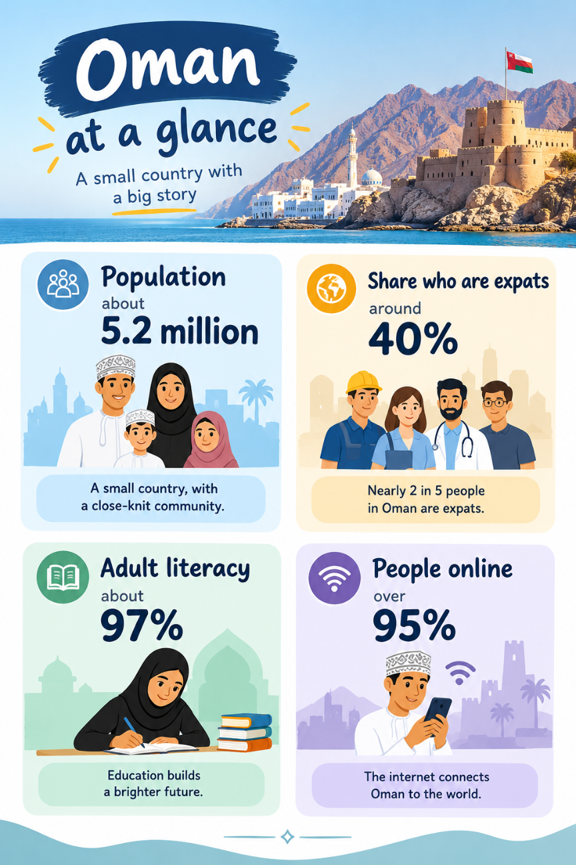
A few numbers put today’s Oman in context:
Oman today | Approx. figure | Why it matters for school choice |
Population | about 5.2 million | A small country, so good school seats are limited |
Share who are expats | around 40% | Lots of families on 2–3 year postings |
Adult literacy | about 96% | Parents care a lot about education |
People online | over 95% | Online school is realistic almost everywhere |
Still, “much better than before” is cold comfort when your kid’s miserable. Here’s what comes up again and again.
No seats
The Muscat schools everyone wants (think Qurum, Al Khuwair, MSQ) tend to be full long before term starts. Land in October and you’re often choosing between whatever’s left.
Money
Tuition’s only the headline. Then there’s the bus, two sets of uniform because one is always in the wash, books, the Jebel Akhdar trip, the PE kit that somehow costs more than your own trainers. Three kids in, and school can quietly become the biggest bill after rent.
Life outside the capital
Duqm, Ibri, Sur, Nizwa. Lovely places, not many school options, and American curriculum ones are thin on the ground. Some parents drive more than an hour each way. Others park the kids with an aunt in Muscat from Sunday to Thursday, which, let’s face it, nobody loves.
Kids who are wiped out by 8 am
Alarm at 5:30. Crawl down Sultan Qaboos Street. Bus stops at what feels like every house in the neighbourhood. Some children have been up for two hours before the first bell. Throw June heat on top and, well.
One speed for the whole room
A teacher facing a full class has to pitch it at the middle. The quick kid gets bored and starts doodling. The one who’s lost keeps their head down. Give it a couple of years and that second child is convinced they’re “just bad at maths.” Usually they weren’t. They needed ten more minutes.
Learning by heart
A lot of mums and dads say the same thing: my child can recite the page, but ask them why and there’s silence. Universities want the opposite. So, increasingly, do employers in Oman.
English that stalls
Chatting in English? Most kids here manage fine. Writing a 1,500-word university essay, or keeping up in a first-year lecture hall in Toronto? Different story entirely.
The expat shuffle
Gas field engineer, embassy staff, hospital consultant. Two or three years in Oman, then Abu Dhabi, or KL, or home. New country, new curriculum, and gaps nobody spots until exam season.
Kids the timetable wasn’t built for
The 14-year-old swimmer in the pool at 5. A child in and out of hospital. Someone with dyslexia who needs longer than the bell gives. A fixed 7:30-to-2:30 day just doesn’t bend for them.
Recognise yourself in any of that? Keep going.
Okay, So What Are We?
An American school. That’s really it, except the classroom lives on a screen instead of down the road. We opened in 2014, and these days our students log in from well over a hundred countries, Oman very much included.
People sometimes picture a tutoring website or a YouTube playlist with a logo on it. Not quite. There are actual teachers, a timetable, marked homework, report cards, and a US high school diploma for the ones who make it to the end.
When parents explain why they picked us, a handful of reasons keep popping up:
over a decade of doing this, with families scattered across the Gulf, South Asia, Africa, and Europe
an American curriculum, plus international accreditation (the website has the current details, worth a look)
classes small enough that a teacher actually spots the kid who’s gone quiet
classmates from Kenya, India, UAE, Spain, Korea… which is its own kind of education, really
Why bang on about 2014? Because of COVID. At the peak in 2020, UNESCO estimated that school closures affected about 1.6 billion students worldwide. Online schools sprang up everywhere, and a fair number had folded by 2022. We’d already had six years to figure out what works on a screen and what flops, so when the world went online, nothing here had to be cobbled together overnight.
Where Online School Actually Helps
We won’t pretend it fixes everything. It does fix a surprising amount, though.
Getting in
No building means no “sorry, Grade 6 is full.” Families who fly into Muscat in November can often have a child sitting in a live class the week after.
The money side
You’ll still pay tuition, obviously. What tends to vanish is the stuff orbiting around it:
the bus
uniforms, and the bag that splits every single term
petrol (and your sanity in traffic)
most of the printed textbooks, since nearly all of it is digital now
With two or three kids, that’s real money by June. Ask admissions about sibling discounts while you’re on the phone, too.
Where you live stops mattering
A girl in Sohar, a boy in Salalah, someone in a tiny village past Bahla: same class, same teacher, same lesson. For families in the interior, this is honestly the biggest change of all.
Calmer mornings
The commute becomes a few steps down the corridor. Kids sleep a little later, eat breakfast sitting down for once, and actually show up awake. In Ramadan, or the middle of July, that’s no small thing.
Their own speed
Didn’t get fractions today? Rewatch it after dinner. Already knew it? Skip ahead. Teachers can see which questions a student missed and nudge them before the gap turns into a canyon.
Thinking over cramming
American-style classes lean on projects, debates, and writing. A science unit might wrap up with a student working out how much water their own family wastes in a week, and what they’d change. Worksheets still exist, sure. They’re just not the whole show.
English that sticks
When maths, science, and history all happen in English, the language stops being a subject and turns into something kids just use. Give it a year or two, and the confidence shows, on the SAT, on IELTS, in university essays. That matters: US universities alone host over a million international students a year, according to the Open Doors report.
Moving? Bring the school.
Next posting is Doha, or Dubai, or back to Chennai? Same login. Same teachers. Same transcript. That’s it, nothing else to sort out.
Days that bend
The swimmer trains at dawn and studies after lunch. The kid recovering from an operation keeps up from the sofa. Frankly, building the day around the child instead of the other way round should’ve been normal ages ago.
Grades We Teach
KG right through to Grade 12.
Stage | Grades | Roughly what happens |
Elementary | KG to Grade 5 | Reading, writing, numbers, science, and (we hope) liking school |
Middle | Grades 6 to 8 | Harder subjects, and learning to manage their own time |
High school | Grades 9 to 12 | Credits, electives, advanced courses, the diploma |
Most families go full time, so we’re the child’s main school. A few just take a course or two alongside their regular school, to catch up in maths, say, or to study something their school doesn’t offer. Strong students can pick advanced classes that look nice on a university application. The subject list shifts a bit every year, so ask for the current one rather than trusting an old brochure.
The diploma, and Oman specifically
Abroad, an accredited US diploma generally goes through without drama. Staying in Oman for university is a slightly different road. You’ll usually need an equivalency from the Ministry of Higher Education, Research and Innovation, and the rules do get updated now and then. Our two cents: look into it around Grade 9. Not three weeks before graduation.
Is It Right for Your Kid?
Omani teens aiming for universities abroad (the American transcript and the English both help a lot)
expat kids whose families move every two or three years
families out in the interior or down south, nowhere near Muscat’s international schools
quiet kids, who often find their voice online in a way a crowded room never allowed
young athletes, musicians, anyone with a heavy training schedule
children managing a long-term health condition
kids who’ve been bullied and badly need a reset
the fast ones, sick of waiting for everyone else
Where does it get tricky? With a child who genuinely can’t focus unless someone’s sitting next to them. That’s not a deal-breaker. It just means a parent, a grandparent, or a tutor nearby for the first few weeks. Tell admissions honestly what your child is like. If we don’t think it’ll work, we’d rather say so now.
A Normal Day, More or Less
Meet Aisha. She’s made up, but she’s pretty typical: Grade 8, lives in Al Mawaleh, not a morning person.
Time | Aisha |
7:00 am | Drags herself out of bed. Breakfast with the family; nobody shouting about the bus |
8:00 am | Live maths |
9:30 am | Science project, at her own pace |
11:00 am | Break. Bothers her little brother |
12:00 pm | Live English with kids from four or five countries |
1:30 pm | Lunch, prayer |
2:30 pm | Homework, plus a message to her teacher about the bit she’s stuck on |
4:00 pm | Done. Quran class some days, swimming others |
Notice what isn’t in there? Traffic. A backpack that weighs as much as she does. Corridor chaos.
Her cousin Hamed is down in Salalah, near enough, on the same schedule. He just spends his afternoons playing football, and when khareef rolls in, he’s out in the mist instead of staring at it through a classroom window.
Live class times depend on grade and subject, so do check how they line up with Oman time.
Signing Up from Oman
All online, start to finish. Most families go from first phone call to first class in a few days.
Visit our website. Grades, subjects, fees.
Book a free call with an admissions counselor and tell them about your child, the good and the tricky.
Attend a Free Live Demo
Dig out the paperwork, usually a passport or Omani ID and the last couple of report cards.
Fill in the application, upload everything.
We look at past records and sometimes ask for a short placement test to get the grade right.
Pick a payment plan, confirm the seat.
Your child gets a login, a timetable, and a quick tour of the platform.
First live class. Cue nervous excitement.
Kit-wise: a laptop or desktop, a steady connection (ordinary home fibre or a decent 4G/5G plan is normally fine), a headset with a mic, and a corner of the house that’s theirs.
Stuff That Helps (Learned the Hard Way)
Month one is messy for almost everyone. Forgotten passwords, a webcam that won’t cooperate, at least one morning when nobody wants to get up. It passes.
- Same wake-up and start time every school day. Routine quietly does half the work.
- Give them a real desk. Not the majlis. Definitely not facing the TV.
- At dinner, one question: “What was the hardest bit today?” That’s enough.
- Reply to teachers, turn up to parent meetings. Small problems stay small that way.
- Put friends on the calendar on purpose. Football Thursday, cousins Friday, a club midweek.
- When school’s over, get them off the screen. Winter evenings on the beach in Shatti are hard to argue with.
- Praise the effort, not only the grade.
And the big one, the question nearly every Omani parent asks: won’t they be lonely? Fair worry. In reality, kids chat with classmates in every live lesson and team up on projects, and the hours they used to spend on a bus usually end up going to family, sport, and friends down the street.
Last Thing
No school’s perfect. Ours included. But if waiting lists, fees, distance, or a stiff timetable are holding your child back, it’s at least worth a look at something that’s been quietly working for families since 2014.
What we offer Omani and expat families is pretty simple: a seat without the queue, an American curriculum wherever you happen to live, and a school that stays put even when you don’t.
Easiest next step? A free call with admissions. Bring the awkward questions too, the ones about cost and friends. You’ll know pretty quickly if we’re fit.
Note before publishing: check the latest accreditation, fees, subjects, and Oman equivalency rules with the school and the ministry.
Suggested Read
The Educational System in Oman: A Bridge to World Learning for International Schools
Mira Lew
Nov 18, 2026