
10 Study Tips That Actually Work for ADHD Kids in Online School
ADHD isn't a focus problem. I know that sounds strange — it's literally in the name — but bear with me. Kids with ADHD can absolutely focus. Sometimes they focus so intensely on something that you can't break through to them at all. What they struggle to do is choose where that focus goes and keep it pointed there on command.
My son spent 45 minutes last Tuesday staring at a blank Google Doc.
The assignment was three paragraphs. He knew the topic. He'd done the reading. He just couldn't start.
If you've been there — if you've sat next to your kid watching the cursor blink while the clock moves and the frustration builds on both sides of the table — then you already understand something that most articles about ADHD and studying completely miss.
It's not about trying harder. It never was.
I'm not going to give you a list of tips and tell you they'll fix everything. They won't. But some of them will help. And a few of them might genuinely change how your days go — if you actually use them and don't just read them.
Let's start with the thing nobody says out loud.
Your Kid's Brain Isn't Broken. It's Just Running Different Software.
ADHD isn't a focus problem. I know that sounds strange — it's literally in the name — but bear with me.
Kids with ADHD can absolutely focus. Sometimes they focus so intensely on something that you can't break through to them at all. What they struggle to do is choose where that focus goes and keep it pointed there on command.
That's the actual problem. Not laziness. Not attitude. Not caring enough.
ADHD — Attention-Deficit/Hyperactivity Disorder — is the most commonly diagnosed neurodevelopmental condition in children. It affects how the brain manages attention, organization, self-control, motivation, and time. The part of the brain that handles "okay, I need to start this thing now even though I don't want to" works differently in ADHD brains. Not worse. Just differently.
And it hugely responds to the environment. Same kid. Different environment. Often, completely different results.
Infographic — ADHD by the Numbers
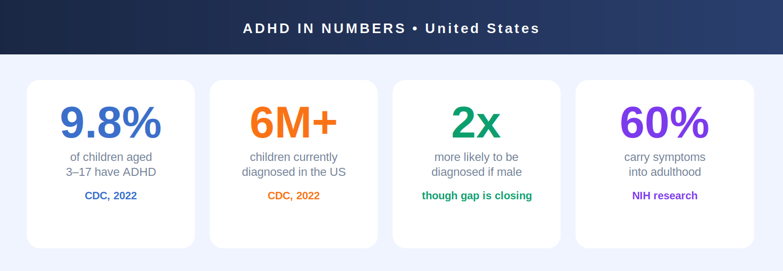
Sources: Centres for Disease Control and Prevention (CDC) 2022 National Survey of Children's Health; NIH neurodevelopment research.
That's why ADHD often looks so confusing from the outside. A child can be incredibly bright, understand the material perfectly, and still struggle to finish assignments or stay organized. It's not a sign of laziness, poor parenting, or lack of intelligence. It's a different way of processing and managing information — and when children are given the right tools and the right learning environment, they can absolutely thrive.
What ADHD Actually Looks Like Day to Day
Every child experiences ADHD differently. Some are constantly moving and talking. Others are quiet and easily overlooked because their struggles happen internally. The most common patterns parents notice fall into three overlapping categories.
Infographic — How ADHD Shows Up in Children
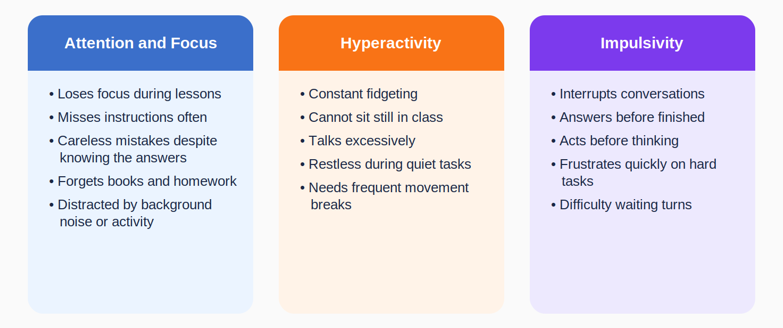
In an online school setting, these patterns show up as logging into class but not really paying attention, opening multiple tabs during lessons, starting assignments but rarely finishing them, missing deadlines despite repeated reminders, and taking far longer than expected on tasks that seem simple.
If that sounds familiar — you're not alone, and none of it is your fault.
Why Online School Is Harder for ADHD Kids (And Why It Can Also Be Better)
Online learning gives students flexibility, but it also removes a lot of the environmental scaffolding that ADHD brains depend on.
In a traditional classroom, there are at least some barriers between a child and their distractions. At home, everything competes for attention. The phone is nearby. The TV is nearby. The dog wants attention. A sibling walks through the room. Even a single notification can completely derail a lesson.
"For ADHD students, maintaining focus at home requires a level of self-regulation that can be genuinely exhausting — not because they're not trying, but because the environment is working against them."
There's also what researchers call time blindness — the genuine difficulty of knowing how much time has passed or how long a task will take. No school bell. No teacher is moving the class to the next subject. No visual cue that time is moving. It just disappears. And then suddenly it's 2 pm, and nothing's been done, and nobody's quite sure where the morning went.
And then there's starting. Which is honestly the hardest one.
Getting started on a task — especially a big one, or a boring one — is disproportionately hard for ADHD brains. It's not procrastination in the way people normally use that word. It's more like trying to push a car that won't start. You're not being lazy. You're just not moving yet. And the harder you stare at the task, the less it often moves.
That said, online school isn't all bad for these kids. A child who had a rough morning doesn't have to perform for six hours regardless. A child who needs extra time can take it. A child who is easily overstimulated by noise, crowds, and the social complexity of a school hallway just doesn't have to deal with that — which frees up an enormous amount of energy for actual learning. The goal is to take that potential and build the right structure around it. That's what these tips are for.
10 Study Tips That Actually Work for ADHD Kids in Online School
1 Build a Routine That Has Room to Breathe
Not a rigid schedule. Not fifteen items colour-coded by subject with five-minute windows. That's going to collapse by Tuesday.
What works is a skeleton. Same wake-up time every day. School starts at the same time. Lunch happens. School ends at a defined point. Within that structure, there's flexibility — but the edges are fixed.
Why this matters: every decision your child has to make before they sit down to work costs them mental energy they'd otherwise spend on the work itself. A predictable routine removes most of those decisions. Write it down somewhere they can see it. Include the transitions — when they eat, when they move, when the day is over. Ambiguity is genuinely the enemy here.
2 Never Say "Do Your Essay." Ever.
"Do your essay" is not a task. It's a category of tasks. And a child with ADHD, looking at a category of tasks, sees a wall.
Here's what you say instead: "Open the document." That's it. Just that one thing. Then: "Write the title." Then: "Write one sentence about what you're going to argue." One sentence.
This isn't about tricking them. It's about the fact that momentum is real, and the hardest part is almost always getting started. Once an ADHD child is actually moving — fingers on the keyboard, words appearing — they can often keep going longer than either of you expected. The wall is at the beginning, not in the middle.
Break every big thing into the smallest steps you can imagine. Steps that take five minutes max. Check them off one by one. The act of crossing something out is more motivating than it has any right to be. Use it.
3 Use a Visual Timer — Not Just Any Timer
The Pomodoro technique — 25 minutes of work, 5-minute break, repeat — works well for a lot of ADHD kids. Not because of anything magical about the number 25. Because the work is finite. "I just have to focus until the timer goes off" is manageable in a way that "focus until you're done" simply isn't.
Start shorter if 25 minutes is too much. Try 15. Try 10. Find the real number — the one where your child can actually focus without needing prompting every few minutes. Build up from there.
Get a physical timer if you can. Something they can see counting down, not just hear when it goes off. ADHD brains struggle with invisible time. A visual countdown gives them something to track. A sand timer works. So does a Time Timer. Even a wall clock they can watch matters more than you'd think.
4 Set Up the Space Before the Lesson, Not During
Every minute your child spends adjusting their environment during learning is a minute the lesson is losing them. Do it before.
Phone in another room — not face down on the desk, actually in another room. Tabs closed. Headphones on if noise is an issue. Water on the desk so thirst doesn't become the reason to get up. Snack nearby for the same reason.
And if you can manage it — a consistent spot. Same chair, same table, every school day. The brain learns that this specific place means work, and over time, just sitting there starts to shift your child's attention toward a working mode. It takes a few weeks to build. But it builds.
5 Movement Is Medicine — Stop Treating It Like a Reward
This is probably the most counterintuitive tip and probably the most important.
A ten-minute walk before a lesson will do more for your child's focus in the hour that follows than almost anything else on this list. That's not a parenting theory. That's neuroscience.
Infographic — Why Movement Works for ADHD Brains
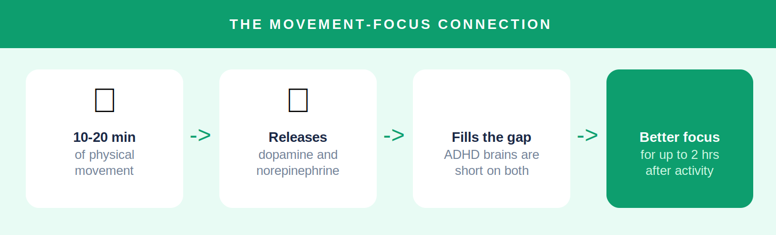
Source: Ratey JJ, Hagerman E. Spark: The Revolutionary New Science of Exercise and the Brain. Supported by peer-reviewed studies on aerobic exercise and executive function in children with ADHD.
Exercise isn't a nice-to-have. For a lot of these kids, it's genuinely functional. Put movement in the schedule — before the first lesson, between subjects, after lunch — not as a treat for finishing work, but as part of the process.
And when your kid is squirming in their chair, wriggling, bouncing their leg, standing up and sitting back down — they're not being difficult. They're self-regulating. Let them move. It helps more than telling them to sit still.
6 If It's Not Written Down Somewhere Visible, It Doesn't Exist
Your child knows their class starts at 10. They know the assignment is due tomorrow. They know all of this. They will still be surprised when 10 arrives.
This isn't forgetfulness in the normal sense. It's time blindness again — the information is there, but it's not connected to any felt sense of urgency. Until suddenly it is, and it's too late.
The fix is visual. Not verbal reminders — those evaporate the moment you stop talking. What sticks is a whiteboard with today's three tasks on it. A sticky note on the monitor. A colour-coded calendar at eye level. Notifications that go off an hour before something's due, not five minutes. The less they have to hold in their head, the more room their heads have for actual learning.
7 Do Something With the Information — Anything
Reading is brutal for a lot of ADHD kids. The words go in, but very little stays.
So instead of just reading, read a paragraph, close the book, and say out loud what you just read. Draw it. Explain it to someone as if they know nothing about it — which genuinely helps, because the act of teaching something forces the brain to organise it. Write the three key points on index cards. Record a voice memo explaining the concept.
The principle is simple: active beats passive every time. The more your child does something with information — reorganises it, argues with it, explains it, draws it — the more of it survives. Passive reading leaves almost no trace. Active processing leaves something you can actually build on. It takes more time than just reading. It's worth it.
8 Goals for Today — Not the Week, Not the Term
Three things. Written in the morning. Crossed off when done. Reviewed at the end of the day together.
ADHD kids often have a really distorted sense of their own progress. A day where they finished three things but didn't finish a fourth can feel like failure. The undone stuff looms larger than the done stuff. A physical list that shows what actually happened is concrete evidence against that feeling.
Keep the goals small enough to be genuinely winnable. This isn't lowering the bar. It's building the habit of succeeding — which, repeated enough times, starts to become a real part of how a child sees themselves.
9 Specific Praise, Right Now — Not Later
"Good job today" doesn't land. It's too vague and too late.
"You stayed with that maths problem for twenty minutes and figured it out yourself" — that lands because it's specific about what they did, not just that they did something.
Connect the praise to effort and strategy, not outcome. A child who got a poor mark but tried a new approach deserves to hear that specifically. A child who managed the morning better than usual deserves to hear that specifically, today.
The reward itself doesn't have to be big. Extra time on something they enjoy. Choosing dinner. A favourite snack. The size isn't the point. The immediacy and consistency are. ADHD brains respond strongly to clear cause and effect — this happened, so this happens — that works.
10 Find a School That's Built for Your Child — Not One That Tolerates Them
Everything above works better inside an environment designed for this.
Small classes. Flexible scheduling. One-to-one support when needed. Teachers who know your child's name and their learning style, not just their seat number. Lessons they can go back and re-watch. Pacing they can control.
That's what we try to do at International Schooling. Not accommodate ADHD students as a special category — just teach them properly, in the environment that actually works for them. When the school is pulling in the same direction as you, everything above becomes easier. Still hard sometimes. But easier.
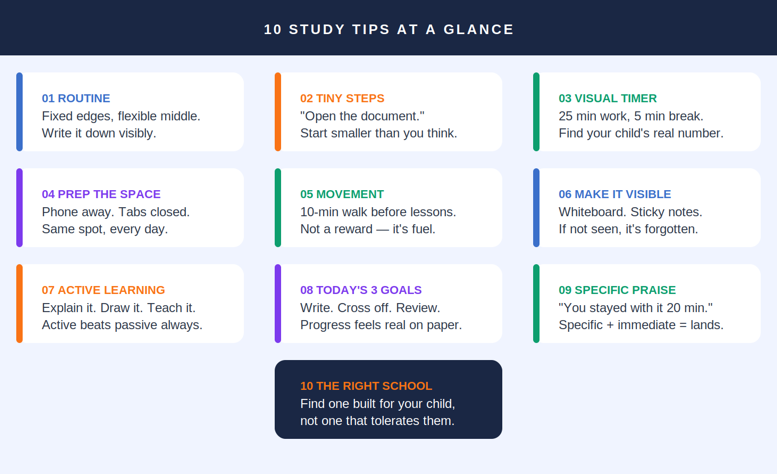
Infographic — 10 Tips at a Glance
Why Online School Ends Up Being the Right Fit for So Many of These Families
Online school wasn't designed with ADHD in mind. But for a lot of these kids, it fits better than anything that was.
The flexibility that most students treat as a nice perk is genuinely structural support for ADHD learners. Control over pacing, environment, and schedule means fewer systems fighting against how their brain actually works — and more energy left for learning itself.
None of this replaces proper support. If you're worried about your child, talk to your doctor. ADHD is real, the right support matters, and school alone isn't a treatment. But if you've already got the diagnosis, you're already managing it, and what you're looking for is a school environment that works with your child instead of constantly against them — online school is often exactly that.
Suggested Reads
Mira Lew
Jul 02, 2026