Online Education: The Next Evolution of the Global Education System
Today, online education represents the next natural step in this evolution. Not as a replacement for traditional schooling, but as an expansion of what education can be in a modern, interconnected world.
How Virtual Schooling Is Shaping a More Accessible, Flexible, and Student-Centric Future
Education has always evolved alongside society.
As the world changes, through technology, mobility, population growth, and shifting lifestyles, the way students learn must evolve as well. From traditional classrooms to digital platforms, each transition has been driven by the same goal: making education more effective, more accessible, and more aligned with real-world needs.
Today, online education represents the next natural step in this evolution. Not as a replacement for traditional schooling, but as an expansion of what education can be in a modern, interconnected world.
Expanding Access to Quality Education Worldwide
One of the most meaningful contributions of online education is its ability to extend learning opportunities beyond geographical and economic boundaries.
In many parts of the world, access to consistent, high-quality schooling remains a challenge due to economic limitations, logistical constraints, or limited local resources. Online education helps bridge this gap by offering structured learning environments that can be accessed with minimal physical requirements.
Students are no longer confined by their geography. Where once-ideal curricula, qualified educators, and academic continuity may have been difficult to achieve, it is now possible with the right digital framework. This greater access opens education to motivated and capable learners, irrespective of circumstances.
Supporting Passion, Talent, and Individual Learning Paths
Every child learns differently, and not every student’s potential fits neatly into a fixed classroom schedule.
Young athletes, performers, innovators, researchers, and students who are passionate about their skills and talents often need flexibility to integrate their skills with their learning. Conventional education systems, though helpful for the majority, are not necessarily aligned with flexible pathways.
Online education provides a solution where structure and freedom can coexist. Students can preserve their academic growth while dealing with training schedules, creative pursuits, or niche interests. Education will conform to the student’s talent and abilities, so that passion and education can grow side by side without competing for time.
This approach encourages deeper engagement, self-motivation, and a more meaningful connection to learning.
Learning Continuity Through Safety and Stability
Safety plays an essential role in effective education.
In certain regions, students face challenges related to transportation, social environments, or instability that can make daily travel to physical schools difficult or unsafe. Even when schools remain operational, uncertainty around travel, infrastructure, or social concerns can disrupt consistent learning.
Online education provides a stable platform for students to gain knowledge from a secure setting. The aspect of education not being interrupted by external circumstances does not exist within online education, as students stay focused on development as opposed to uncertainty.
This continuity fosters confidence, emotional well-being, and academic progress, all of which are critical for long-term success.
Education That Adapts to Modern, Mobile Families
While many families remain settled, there is a growing group of parents whose work or lifestyle involves relocation, travel, or cross-border movement. For these families, traditional schooling can present challenges related to curriculum changes, academic gaps, and frequent adjustments.
Online education provides consistency for such learners.
A unified academic framework that travels with the student ensures uninterrupted learning regardless of location. Whether a family relocates temporarily or permanently, education remains stable, familiar, and structured.
This flexibility supports families who value continuity without compromising academic standards.
A Scalable Approach for Growing, Urbanized Cities
As cities become denser and populations increase, education systems must adapt to changing urban realities.
Conventional schooling depends to a large extent on infrastructural support, involving campus, classroom, and transport facilities, whereas online education provides an alternate solution that does not put much pressure on these infrastructural systems.
Online schooling decentralizes the places of learning to allow efficient scaling of education with growing populations. This allows students to learn effectively without constraints due to overcrowded environments, long commutes, or rigid scheduling.
This model supports sustainable growth while keeping student experience at the center.
Addressing the Limitations of Conventional Schooling Models
Physical schooling has served generations well, but it also comes with limitations.
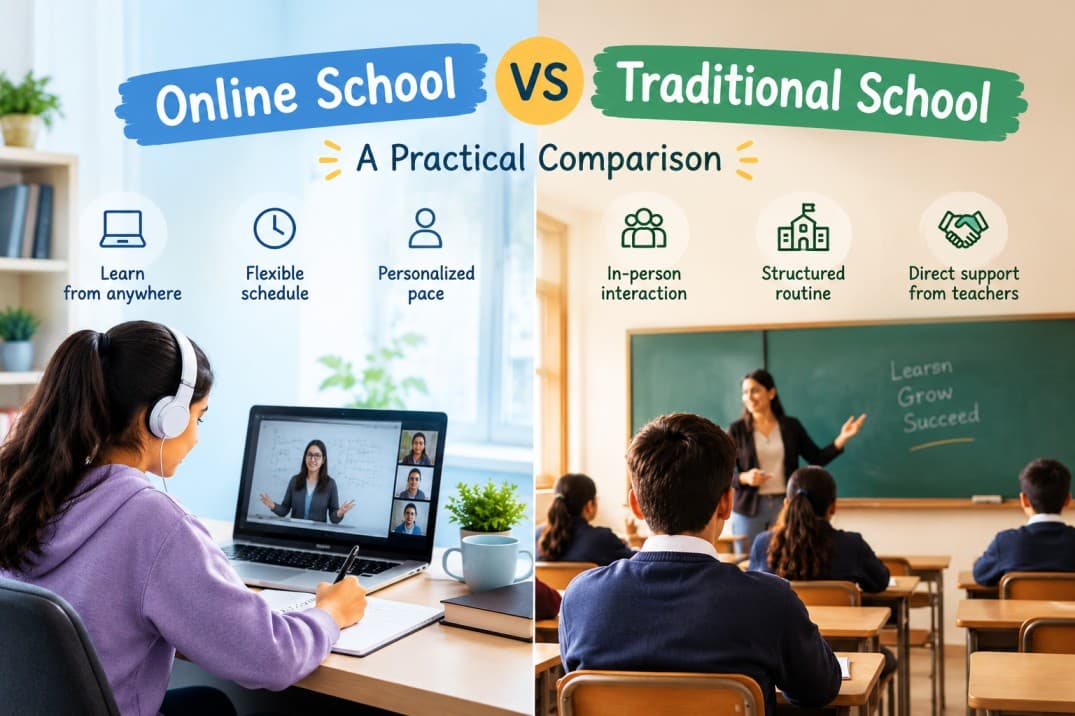
Strict timetables, a fixation on standardization, geographical dependencies, and practicalities might render traditional models less flexible in accommodating the needs of today’s students. Online education models overcome the shortcomings in the latter by providing the benefits of flexibility, standardization, and geographical independence.
Rather than replacing conventional education, online schooling strengthens the ecosystem by providing additional pathways that suit a wider range of learners.
Where Platforms Like International Schooling Play a Role
As online education continues to mature, quality, affordability, and student focus become the defining factors.
International Schooling is built around a clear purpose and philosophy that places students at the heart of every decision.
Vision:
To create
smiles for students across the globe with excellent quality online schooling.
Mission:
To change the lives of students with the most accessible and affordable online schooling.
Philosophy:
Each child
is unique and deserves an education aligned with their individual needs, and
every decision is made with the student’s best interest in mind.
By combining flexibility, affordability, and a globally aligned curriculum, International Schooling reflects what modern education is striving to become: inclusive, adaptable, and deeply student-centric.
For families seeking a future-ready education model that aligns with real-life demands, this approach offers both stability and opportunity.
What the Future Holds for Education
The future of education is not defined by one format, but by choice, accessibility, and adaptability.
The evolving world, which continues to grow through unrelenting population growth, irrevocably changing lifestyles, diversification of learning needs, and global connective networking, dictates the need for flexibility in education systems. Online education stands tall as an effective complement to traditional learning. It provides practical solutions that are inclusive, forward-looking, and aligned with the demands of the evolving world.
The next chapter of education is
already unfolding.
And it is shaped by flexibility, access,
and a commitment to putting students first.
Mira Lew
Jan 15, 2026