
Activities to Enable Critical Thinking in your Child
Online schools use a variety of methods to encourage critical thinking in students. However, before we go to them, it is important to understand what critical thinking is and how the idea develop.
How Online Schooling Cultivates Critical Thinking in Students?
For students enrolled in K-12 online schooling, it is essential to develop critical thinking as it equips students with skills like effective problem-solving, enhances their decision-making, improves learning, develops an analytical mind, and makes them more creative as they can break the mold of conventional wisdom. These skills help them not only in their studies but also prepare them for future life and work challenges
Online schools use a variety of methods to encourage critical thinking in students. However, before we go to them, it is important to understand what critical thinking is and how the idea develop.
What is critical thinking?
Although critical thinking has been part of civilization since the Greek city states in works of Socrates, Aristotle, Diogenes, and Plate etc. to the Enlightenment period in works of Rousseau, Locke, Voltaire, etc.
In 1987, the most groundbreaking work on critical thinking was done by scholars Michael Scriven & Richard Paul, called “Defining Critical Thinking”, which provided the most articulate understanding and definition of critical thinking.
The intellectually disciplined process of actively conceptualizing, applying, analyzing, synthesizing, and/or evaluating information is called Critical Thinking.
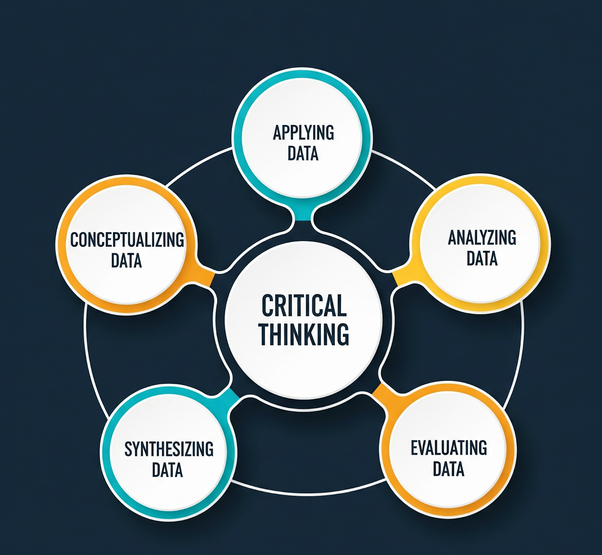
Information is collected or created through means of observation, experience, reflection, reasoning, or communication, which is later incorporated into a belief system and an individual action.
Important elements of Critical thinking
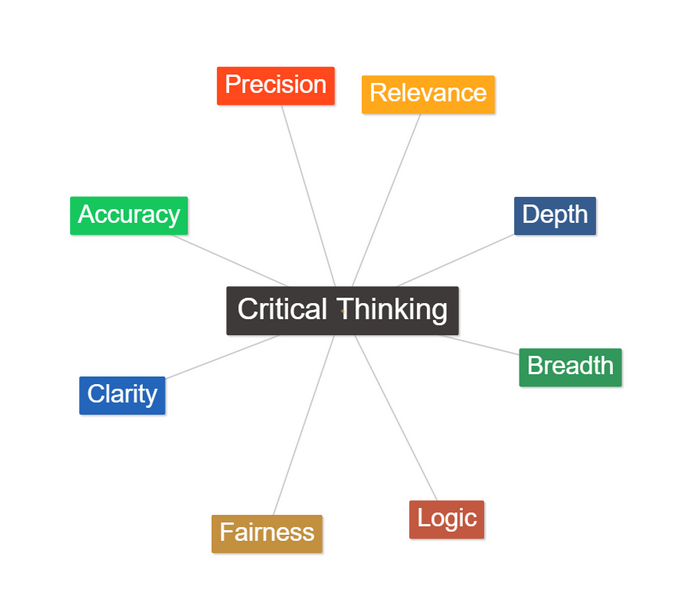
Certain important elements of critical thinking make it more valuable, like clarity, accuracy, precision, relevance, logic, depth, breadth, and fairness
Therefore, it is important to introduce critical thinking in students in their schooling from a very young age. Online schools do not require any physical infrastructure. They can encourage critical thinking in a variety of ways
Ways in which online schools encourage critical thinking among students
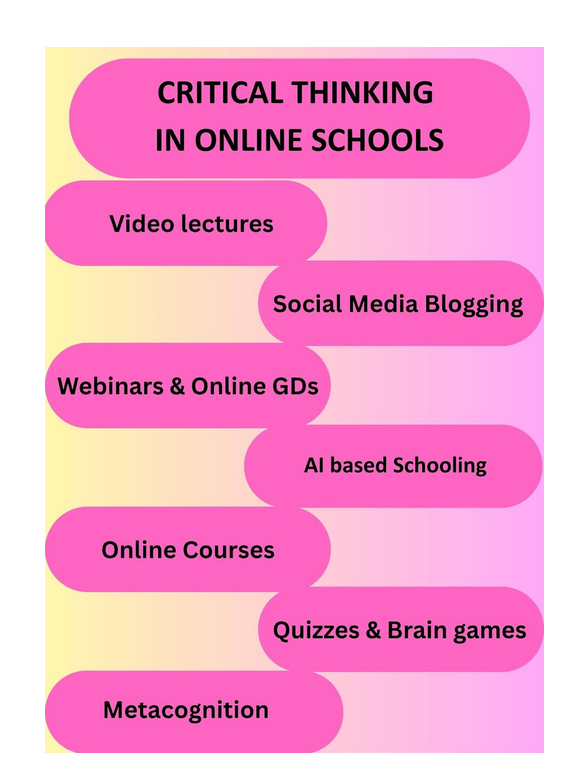
Studies have shown that critical thinking is instilled among students through online schooling in a variety of ways
Video lectures
For many students, it is too boring to study merely through traditional schooling methods like those presented in books and whiteboards. Online classes impart education through interactive videos. Studies by Stockwell (2015), Salina (2012), Hill and Nelson (2011) have shown that critical thinking can be instilled by video lectures as it enhances students’ motivation, engagement, and performance.
Social Media Blogging
Our attention span has gone down considerably. Everyone effectively needs precise information; short videos can ensure higher retention in students. Many teens use social media to gather information, through YouTube shorts, Instagram reels, Facebook reels, and TikTok reels, etc. Virtual schools use social media platforms to help students retain information in a relaxed space. Blogging is a way of journaling where students can express their views on a given topic or challenge norms by interacting with their classmates.
Webinars and Online Group Discussions
To encourage critical thinking among students, it is important to instill values like introspection and inquiry, where students are motivated to ask questions, challenge established beliefs, and seek proof for any claims. Virtual schools conduct online discussions and Q&A sessions, through webinars, online group discussions, and online meetings. This provides not only exposure to expertise on critical thinking but also encourages students to collaborate online to discuss with each other.
AI-based Schooling
It is very important to familiarize children with Artificial Intelligence as many experts believe that AI can be used to strengthen critical thinking among students by helping them to generate quality prompts by using the right keywords, providing precise responses that are directed to questions and ability to ask follow-up questions. AI helps students to ideate certain concepts and make a mind map/ framework to grasp the different concepts.
Online Critical Thinking Courses
Students can enroll in specialized online courses where their critical thinking can be encouraged by learning from experts who help students understand arguments that are presented by others, determine the validity of an argument, and provide reasonable arguments by analyzing every fallacy.
Quizzes & Brain Games
Online quizzes and brain games are fun ways to ensure critical thinking in students by using logic for problem-solving and analytical thinking to find solutions. Tools like simulation games and virtual reality experiences offer myriad ways to explore complex concepts.
Metacognition
Metacognition refers to thinking about our thinking as well as acting on our thoughts. It is one's capacity to reflect on, evaluate and control their own cognitive processes such as decision-making, memory and perception. Since teacher-student ratio is lower in online schools, teachers can pay more attention on students to encourage metacognition. Teachers can help students develop the skills to become self-aware and independent learners.
Studies on Critical Thinking
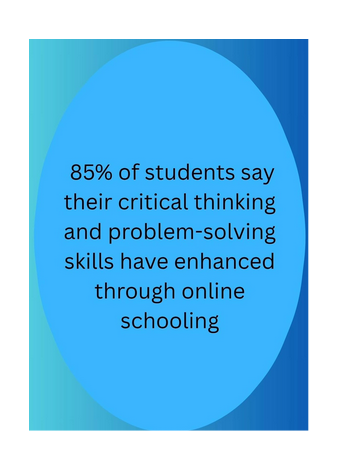
In their survey, Bay Atlantic University found that 85% of students say their critical thinking and problem-solving skills have enhanced through online schooling
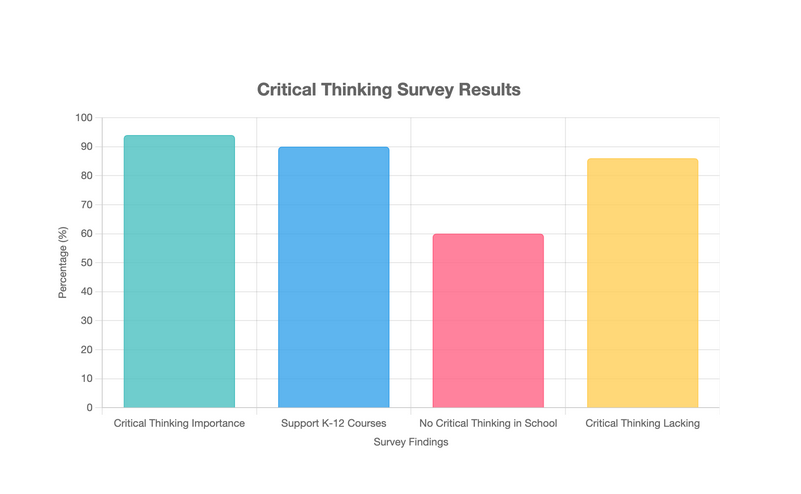
As per a survey by the Reboot Foundation, it was found that:
94% believe critical thinking is “extremely” or “very important.”
90% support critical thinking courses in the K-12 curriculum.
60% reported not having studied critical thinking in public school
86% find critical thinking skills lacking in the public.
To conclude,
Students become rational and independent thinkers through critical thinking as it equips students with skills like the ability to analyze data and evaluate evidence. There are a variety of ways in which online schools encourage critical thinking in students, which makes learning fun as well as interactive for students. Social media, AI, video lectures, Gaming, and other tools are at the forefront of encouraging students to learn critical thinking in online schools.
Frequently Asked Questions
Q.1 Why is critical thinking important in K-12 schooling
Critical Thinking is vital in K‑12 schooling as it equips students with problem-solving, decision-making, analytical, and creative capabilities, which prepares them for both academic success and future challenges.
2. How do video lectures encourage critical thinking?
Online schools use video lectures to motivate students to participate in classes and encourage critical thinking as they make learning fun and provide real-life examples for the same.
3. Can critical thinking be encouraged through webinars?
Virtual schools encourage students to have group discussions through webinars; these provide students with the opportunity to question one another, evaluate each other, and find solutions to problems effectively.
4. How do quizzes and interactive games encourage critical thinking?
Quizzes and interactive games enhance skills like problem-solving and decision-making creatively. These are the hallmarks of critical thinking
5. How do online schools ensure critical thinking through metacognition?
Online schools have smaller teacher‑student ratios, enabling teachers to provide students with personal guidance towards metacognition. Metacognition gives students opportunities to introspect on their thought processes and makes them more self-aware.
Suggested Read
Mira Lew
Jan 07, 2026