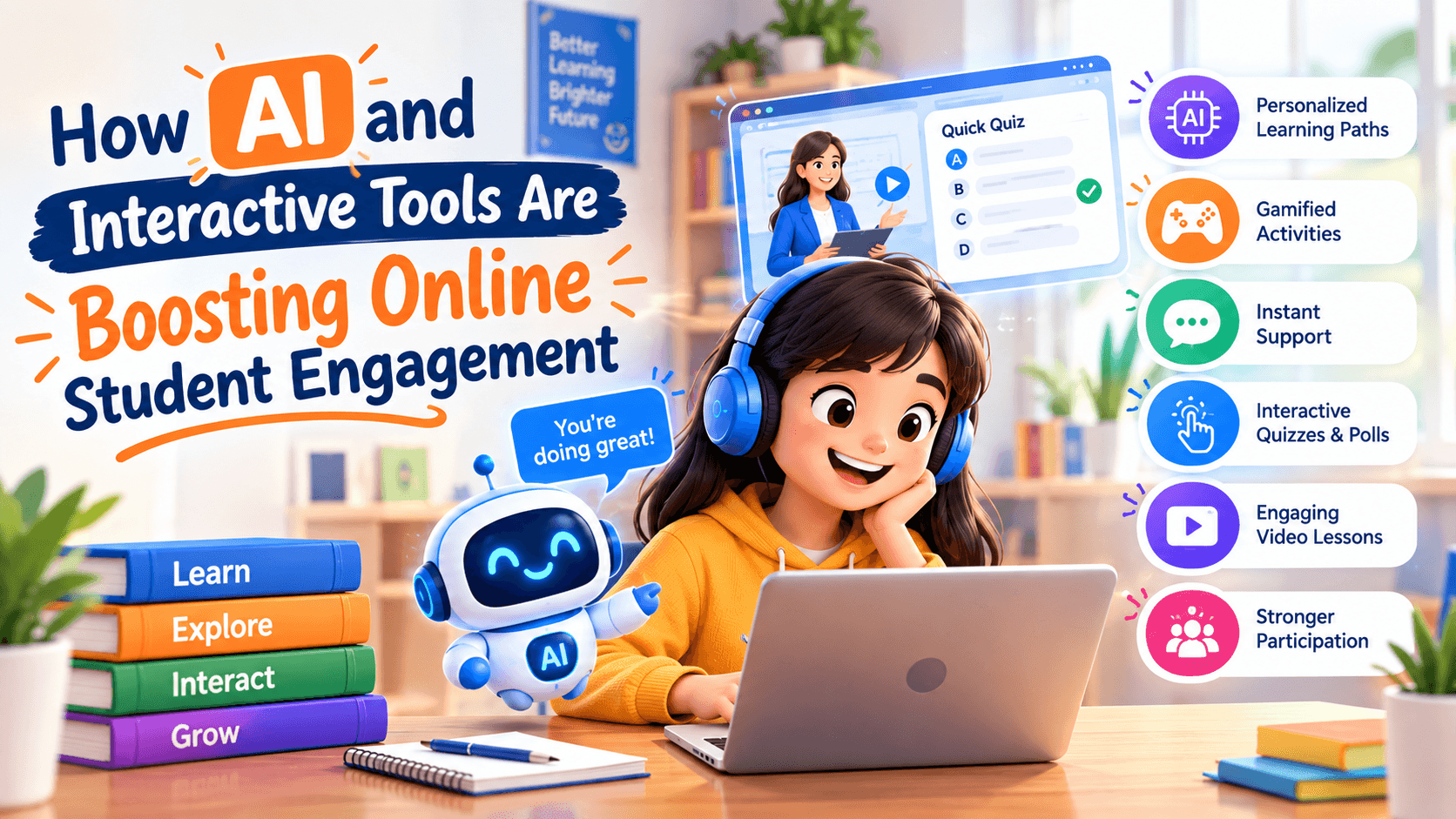
How AI and Interactive Tools Are Boosting Online Student Engagement
Online learning solved the access problem pretty well. Anyone with a laptop and a decent connection could take a course from a university on the other side of the world. Great. But it created a new problem: attention.
A few years ago, "online learning" mostly meant a recorded lecture and a PDF of slides. You logged in, half-watched a video, and logged back off. Nobody pretended that counted as engagement. Everyone knew it. There just wasn't a better option yet.
That's changed, and fast. AI tutors, live polls, gamified quizzes, adaptive learning platforms — online classrooms now feel a lot more like a conversation than a broadcast. This isn't just a vibe teachers have picked up on either. The numbers back it up.
Why Engagement Became the Problem to Solve
Online learning solved the access problem pretty well. Anyone with a laptop and a decent connection could take a course from a university on the other side of the world. Great. But it created a new problem: attention.
Think about it from the student's side for a second. A lecture video has no idea whether you're watching it or scrolling on your phone with three other tabs open. A static worksheet doesn't notice when you're stuck — it just sits there. Traditional e-learning was built to deliver content, not to hold anyone's attention or respond when things stopped clicking. Students would enroll, get through the first couple of modules with real interest, and then quietly vanish by week three. By the time anyone noticed the drop-off, it was already too late.
That gap — between delivering information and actually keeping someone engaged with it — is where AI and interactive tools step in. Before getting into what's working, though, it's worth being clear on what "engagement" even means here. It's more than clicking around a screen.
What Engagement Actually Looks Like Online
Engagement isn't the same thing as activity. A student clicking "next slide" forty times isn't engaged — they're going through the motions, and anyone who's ever half-paid attention through a course knows the difference instantly.
Researchers usually split real engagement into four rough buckets. Behavioral: Do they show up consistently and finish what they start? Cognitive: Are they actually thinking through the material or just skimming it? Emotional: Do they feel curious or motivated, or bored and a little anxious? Social: Are they interacting with peers and instructors, or learning in total isolation?
Most traditional online courses were only ever built for the first one. Log in, watch, submit, repeat. AI and interactive tools are really the first serious attempt at supporting all four at once — which is a big part of why the difference feels so noticeable when you actually sit through one of these courses.
The Numbers Behind the Shift
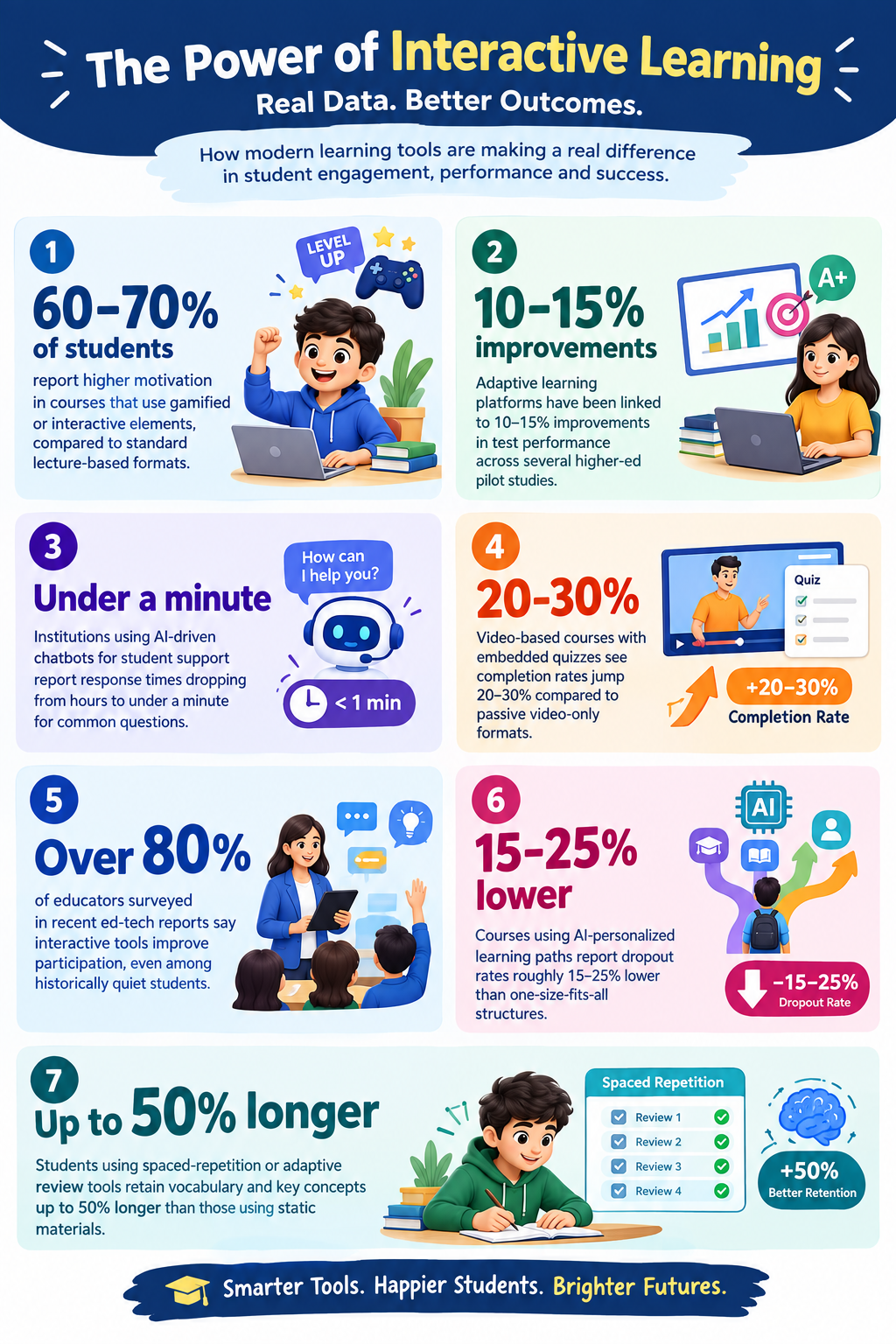
Here's what the data suggests. Treat these as industry estimates, not gospel — worth double-checking against current reports before quoting them anywhere official.
- Roughly 60–70%
of students report higher motivation in courses that use gamified
or interactive elements, compared to standard lecture-based formats.
- Adaptive
learning platforms have been linked to 10–15% improvements in
test performance across several higher-ed pilot studies.
- Institutions
using AI-driven chatbots for student support report response times
dropping from hours to under a minute for common
questions.
- Video-based
courses with embedded quizzes see completion rates jump 20–30% compared
to passive video-only formats.
- Over 80%
of educators surveyed in recent ed-tech reports say interactive
tools improve participation, even among historically quiet students.
- Courses using AI-personalized learning paths report dropout rates roughly 15–25% lower than one-size-fits-all structures.
- Students using spaced-repetition or adaptive review tools retain vocabulary and key concepts up to 50% longer than those using static materials.
Add it up, and the pattern's pretty clear: engagement stopped being a
soft, feel-good metric a while back. It's tied directly to
completion, retention, and performance now — the three things every online
program actually cares about.
What's Actually Driving the Change
AI Tutors and Chatbots
These aren't replacing teachers. What they're doing is filling the gap between office hours. A student stuck on a calculus problem at 11 p.m. doesn't have to wait until morning anymore — an AI tutor can walk through the steps, catch the mistake, and explain why it happened, in plain language, with zero judgment attached.
That last part matters more than people give it credit for. A lot of students don't ask questions in a live class because they're embarrassed to be the one who doesn't get it. Take away the social pressure of raising your hand in front of thirty other people, and suddenly a lot more questions actually get asked.
Adaptive Learning Paths
Instead of every student grinding through the same twenty questions no matter how they're doing, adaptive platforms adjust difficulty on the fly. Struggling with fractions? The system slows down and tries a different explanation. Already ahead? It skips the review and pushes into harder material instead of letting someone sit bored through stuff they've already mastered.
Honestly, this is probably the single biggest shift from old-school e-learning. A textbook can't do this. A recorded lecture definitely can't. Only software that actually tracks performance in real time is capable of it.
Gamification
Points, streaks, leaderboards, badges — sound gimmicky until you look at the retention numbers. Turning a vocabulary list into something game-like, with feedback that hits immediately, taps into the same motivation loop as a regular video game. Duolingo built a whole company on this idea, and plenty of university platforms have quietly copied the playbook: daily streaks, small visible wins, a progress bar that fills up a little more each day.
Here's what people usually miss, though — it's not the badge doing the heavy lifting. It's the loop. Act, get a response right away, adjust. That's what holds attention. The shiny icon at the end is basically decoration.
Real-Time Polls and Live Q&A
Live polling lets an instructor ask "Who's still confused about this?" and actually get an honest answer in seconds, instead of dead silence on a video call because nobody wants to be the one who admits they're lost. Anonymous polling especially changes the whole dynamic — students who'd never raise a hand will click a button without a second thought.
Interactive Video and Simulations
Clicking through a branching scenario or rotating a virtual lab setup with your mouse builds understanding differently than watching someone else do it on a screen. It's the difference between reading about a chemical reaction and running one yourself, minus the risk of anything actually catching fire. Medical schools use this for surgical practice, engineering programs for testing virtual equipment, and language courses build branching dialogue trees that feel like an actual conversation instead of another fill-in-the-blank worksheet.
AI-Generated Practice and Instant Feedback
Beyond tutoring, AI now generates fresh practice problems on
the fly, targeted at whatever a student just got wrong. Instead of a fixed
worksheet everyone gets regardless, the system produces five new
problems aimed straight at the misconception that just showed up. Instant
grading on essays and short answers, while still far from perfect, has cut
feedback time in a lot of writing courses from days down to minutes.
What This Looks Like in Practice
A few real examples, not just theory:
- A
biology course embeds a 3D cell simulation that students can rotate and dissect virtually, instead of
squinting at a flat diagram.
- A
language app times vocabulary review so it shows up right
when you're about to forget a word, not a week too late.
- A
coding bootcamp runs an AI reviewer that flags syntax errors instantly,
cutting the wait for human grading from days to seconds.
- A
university platform drops a two-question poll into a lecture every ten
minutes, just to keep remote students actually
responding instead of zoning out.
- A
history course lets students "interview" a simulated
historical figure for a research assignment.
- A
statistics class swaps a static dataset for a dashboard students can
filter and tweak themselves, watching how one variable moves the whole
picture.
None of these are especially flashy by themselves. Stack them together, though, and you get something genuinely different from ninety minutes of uninterrupted video.
It's Not Just About the Students
It's tempting to frame all of this as a student-side upgrade only, but the workload shifts on the teaching end too — and honestly, that's a big part of why adoption moved so fast.
Grading gets less repetitive once automated feedback handles the basic quizzes, which frees instructors up for the kind of feedback that actually needs a human brain behind it. Engagement dashboards can flag a student quietly falling behind before they fail, not after. One instructor obviously can't hand-tailor material for three hundred different people, but adaptive software gets surprisingly close to approximating that. And when AI absorbs the repetitive back-and-forth, live class time goes back to being used for real discussion, instead of answering the same clarifying question for the fifth time that week.
Where It Doesn't Quite Work Yet
None of this is flawless, and it's worth saying so plainly instead of pretending otherwise.
Over-gamification can backfire — chase a leaderboard long enough and some students start optimizing for the score, not the learning. AI tutors get things wrong sometimes, especially with anything nuanced or subjective, so human oversight still has to be in the loop. Not every student has equal access to the devices or bandwidth these tools quietly assume, which risks widening gaps instead of closing them. Tool fatigue is real too — five platforms with five separate logins per course can undo whatever engagement gains any one of them was providing. Data privacy is a growing concern, since engagement tracking means collecting a lot of behavioral data on students, and institutions need actual policies for how that gets stored. And maybe the sneakiest risk of all: over-reliance. If students lean on an AI tutor to just hand them the answer instead of working through the problem, engagement numbers can look great while real understanding quietly slips.
The schools and platforms that get this right tend to pick a handful of tools and use them well, instead of bolting on every new feature the second it launches. Clear boundaries around what the AI actually does — and doesn't — seem to matter more in the end than how sophisticated the tool is.
Picking the Right Tools Without Overdoing It
If you're actually building or redesigning a course, a few honest questions cut through most of the noise pretty fast. Does this solve a real friction point students hit, or is it novelty for its own sake? Does it play nicely with the platform students already use, or does it demand yet another login? Is the feedback fast enough to actually matter, or does the lag defeat the whole point? Is there any real way to measure whether it's improving outcomes or just activity? Will it hold up for students on slower connections or older laptops?
Starting small — one or two well-chosen tools, expanded only once they've proven they move the needle — tends to beat adopting everything at once and hoping something sticks.
Where This Is Probably Headed
The next stage likely looks like tools that adjust not just to what a student knows, but to how they're feeling about the material in the moment — frustration, boredom, confidence — and respond to that too. AI that can actually hold a conversation about a topic, rather than just quiz someone on it, is already blurring the line between "tool" and "tutor."
Expect more courses to blend AI-driven personalization with live human instruction rather than picking one over the other. AI handles the repetitive, data-heavy work; instructors handle mentorship and the kind of human connection that actually keeps someone coming back week after week. Whether that ends up helping students or just overwhelming them probably has less to do with the technology itself and more to do with how thoughtfully it gets folded into the actual classroom.
The Bottom Line
Online learning stopped being just a delivery method the
moment it started listening back. AI and interactive tools didn't fix
engagement by making everything flashier. They fixed it by making the
experience actually responsive. A student who gets instant feedback, the
right level of difficulty, and a real reason to log back in tomorrow is a
student who's genuinely learning — not just showing up.
Suggested Read
Mira Lew
Sep 19, 2026