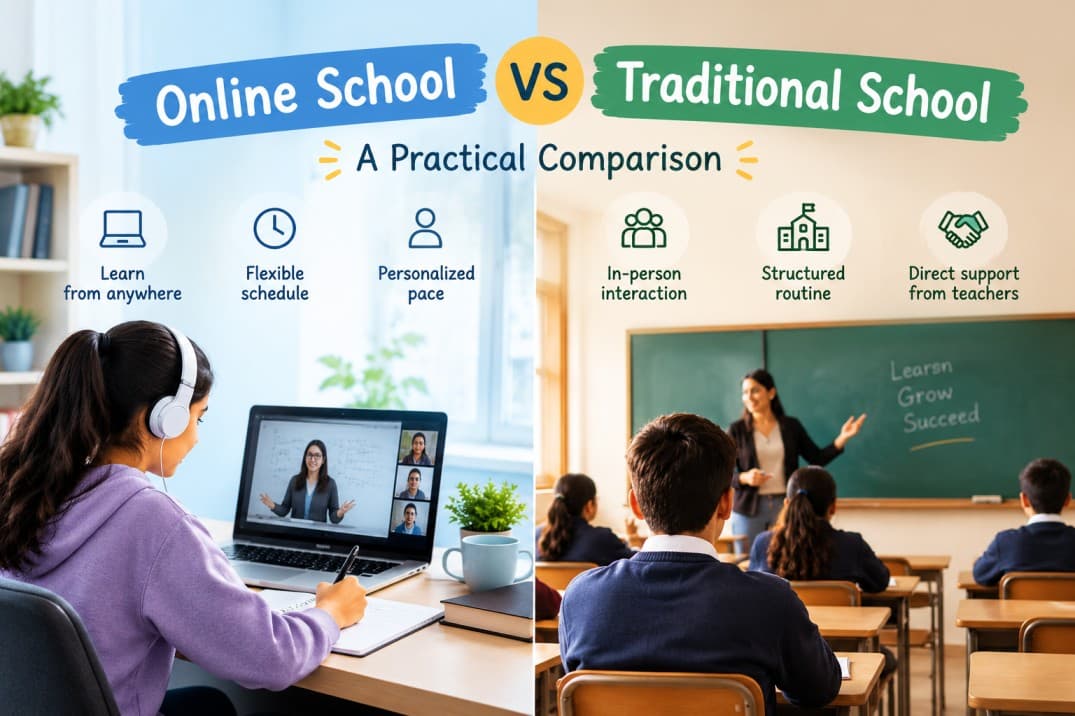
在线学校与传统学校:实用对比(2026 年指南)
在线学校和传统学校并非在争夺“更好”的称号——它们适用于不同的情况。一种学校默认提供结构化的结构和社交互动;另一种学校则提供灵活性和节奏,但需要配合有意识的社交活动。最终的选择取决于您的孩子、您的具体情况,以及对当前实际情况的客观评估。
Every family hits this question eventually, usually around August, staring at a schedule that no longer quite fits. Maybe it's a move. Maybe it's a kid who's struggling in a classroom of thirty. Maybe it's just exhaustion with the daily commute-and-homework grind. Whatever the reason, “online school vs traditional school” stops being an abstract debate and becomes a decision you actually have to make.
There's no universal right answer here. But there is a clearer way to think about it than most articles give you. Let's walk through what actually changes — academically, socially, financially — when a family switches from a traditional classroom to online school, and what it doesn't change at all.
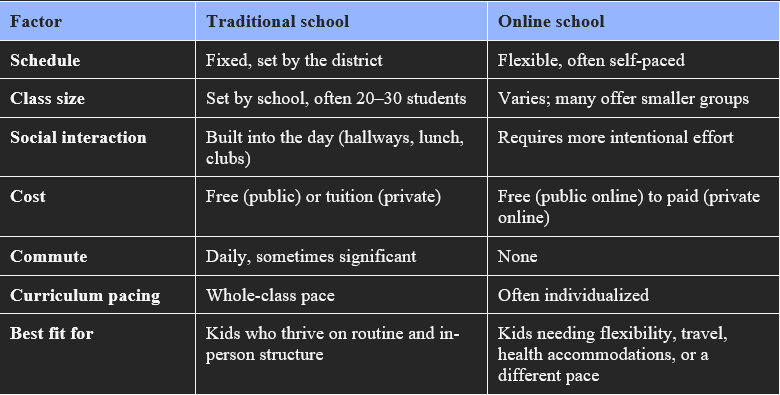
Online school vs traditional school: quick snapshot
Before the details, here's the shape of the comparison:
Academic quality and curriculum flexibility
The biggest myth about online school is that it's academically “lighter.” That's not really true anymore. Accredited online schools follow the same state standards as brick-and-mortar schools, and many offer Advanced Placement courses, dual-enrollment options, and college-prep tracks identical to those offered by traditional high schools.
What actually differs is pacing. A traditional classroom moves at the speed of the group — the teacher can't wait forever for one kid to catch up, and can't sprint ahead just because another kid's bored. Online school, especially in a self-paced model, lets a student spend three days on a concept that's clicking slowly, or blow through two weeks of material in three days if it's coming easily.
For a student who's ahead in math but behind in reading, that flexibility matters a lot. A traditional classroom generally can't offer it. An online program built around individualized pacing can.
Schedule, pacing, and daily life
This is where the difference is most visible day to day. Traditional school runs on a fixed clock: same start time, same period lengths, same daily rhythm, five days a week, roughly nine months a year.
Online school breaks that mold. Families managing a move, a competitive sports schedule, a health condition, or a non-traditional work life often find that the fixed schedule of a normal school day is the actual barrier — not the material. Online schooling gives that time back. Instead of six or seven hours physically in a building plus a commute, a student might complete the same coursework in four focused hours, freeing up the rest of the day for rest, hobbies, sleep, or family time.
That's not automatically a win for every kid. Some students need the external structure that a fixed school day provides — decision fatigue is real, and not every ten-year-old can self-manage a flexible schedule without support. It's worth being honest about which kind of learner is in front of you.
Social interaction and extracurriculars
This is the concern almost every parent brings up first, and it's a fair one. Traditional school builds social interaction into the architecture of the day — hallway conversations, lunch tables, locker-neighbor small talk, none of which anyone has to plan.
Online school doesn't have that built in automatically. It has to be built deliberately: clubs, virtual classes with live discussion, local co-ops, sports teams outside the school itself, and community meetups. Well-run online schools now build a lot of this directly into their programs — live classes, student clubs, and regional in-person events — because they know it's the single biggest hesitation families have.
The honest takeaway: online schooling doesn't guarantee social isolation, and traditional schooling doesn't guarantee a healthy social life. Plenty of kids in traditional classrooms feel just as isolated sitting in a lunchroom they don't feel part of. What matters more than the schooling format is whether a family is actively making sure a kid has a real connection — in whichever setting they're in.

Cost comparison
Public traditional school is free at the point of use, funded through local and state taxes. Public online school (through an accredited virtual charter or state-run program) is also typically free. Private versions of either — traditional private school or private online school — carry tuition, and costs vary widely by program and region.
Where families often see savings with online school isn't tuition — it's the surrounding costs: transportation, some classroom supply fees, extended daycare or after-school care, and in some cases, uniforms. Where online school can cost more is in the setup: a reliable computer, internet access, and sometimes a dedicated learning space at home.
Neither format is automatically cheaper. It depends heavily on the specific school, the family's location, and what “hidden” costs applied to their previous setup.
Mental health and well-being
This part of the comparison gets less coverage than it should. Rates of anxiety and stress among school-age kids have been climbing for years — a trend well documented by the CDC's Youth Risk Behavior Survey and the U.S. Surgeon General's advisory on youth mental health.
Note: pull the exact current figures from the latest CDC YRBS or Surgeon General release before publishing — these numbers shift with each survey cycle.
Academic pressure, social comparison, and packed schedules all contribute. For some kids, the pace and social intensity of a traditional classroom are a major stress source; removing that pressure through a more flexible online format can genuinely help. For other kids, the structure and peer contact of a traditional school are exactly what keeps them grounded, and removing them would do more harm than good.
Neither setting is inherently healthier. What matters is whether the format matches the kid and whether the adults around them are paying attention, regardless of which one they choose.

The chart shown is illustrative only. Verify against a current, citable youth mental health survey before publishing.
What the numbers say (with caveats)
A few data points worth knowing, all of which should be verified against current sources before this article goes live:
• Online K–12 enrollment in the U.S. grew substantially over the past decade, accelerating sharply during 2020–2021 and settling at a higher baseline than pre-2020 levels. (Verify current enrollment figures via NCES — National Center for Education Statistics.)
• Multiple national surveys have found that parent satisfaction with online schooling correlates most strongly with perceived flexibility and reduced daily stress — not necessarily academic outcomes alone. (Verify against a current, citable survey before publishing.)
• Reported rates of persistent sadness or hopelessness among high schoolers have trended upward over the past decade per CDC YRBS data. (Pull the latest release before publishing — figures change with each survey cycle.)

The chart shown is illustrative only. Verify against current NCES enrollment data before publishing.
How to decide what's right for your child
A few honest questions help more than any pro/con list:
• Does your child do better with external structure, or do they thrive when given more control over their own pace?
• Is your family dealing with something — a move, a health issue, a scheduling conflict — that a fixed school day makes harder?
• How much social interaction does your child currently get outside of school hours, and would that change either way?
• What does your child actually say when you ask them directly?
There's rarely one clean answer. Plenty of families do a hybrid: online school for a season during a move or health issue, back to traditional school once things settle, or the reverse.
How to support your child, whichever path you choose
The schooling format matters less than what happens around it. A few things help regardless of which one a family picks:
1. Keep a consistent daily rhythm. Online schooling's flexibility is a strength, but a total lack of routine can backfire. A predictable start time and clear “school hours,” even flexible ones, help kids stay engaged.
2. Protect social time on purpose. If a kid isn't getting it automatically through a hallway and a lunchroom, build it in deliberately — clubs, sports, co-ops, regular friend time.
3. Watch for the same warning signs either way. Withdrawal, sleep changes, and loss of interest in things they used to enjoy matter just as much in a traditional classroom as they do at a kitchen-table desk.
4. Stay connected to whoever is teaching them. Know the teacher or counselor's name, how to reach them, and what support is actually available — academic and emotional.
5. Ask your kid what's working and what isn't. Formats can be adjusted. A kid struggling in one setting isn't stuck there forever.

Where International Schooling fits in
For families actively weighing this decision, International Schooling is built specifically around the flexibility side of this comparison — without giving up real academic standing. It's an accredited K–12 online school designed around a student's actual life: their location, their pace, their family's schedule.
A few things that matter here, especially for families comparing formats:
• Full accreditation. International Schooling is accredited by NEASC and Cognia, and approved and recognized by the College Board and the NCAA — so switching to a more flexible format doesn't mean stepping outside of recognized academic standing.
• Real counselor access. Students get a named counselor for academic planning, college guidance, and social-emotional support — not just a login and a course list.
• Deliberate social structure. Because online learning strips out the built-in hallway interactions, International Schooling builds in regular touchpoints and community so a student isn't just working through material alone.
• Flexible pacing without losing rigor. Lessons are built to fit a student's actual pace and life circumstances — relocation, time zones, health needs — while still meeting the same standards a traditional school would require.
If your family is somewhere in the middle of this comparison — not sure whether flexibility or structure matters more for your kid — it's worth a conversation.
Learn
more or book a free demo at internationalschooling.org.
The bottom line
Online school and traditional school aren't competing for the title of “better” — they're built for different situations. One offers built-in structure and social contact by default; the other offers flexibility and pace that have to be paired with intentional effort on the social side. The right call comes down to your specific kid, your specific circumstances, and an honest look at what's actually working right now.
Suggested Read
Capturing the Benefits of Online Schooling to Improve Student Mental Health
Discover the Top Benefits of Online Learning: A Guide for Success
Do Online Schools Really Support Students with Counseling? Here's What Parents Should Know
Mira Lew
Sep 07, 2026