网络学校真的会为学生提供心理咨询服务吗?家长们应该了解这些。
跟大多数人提起“网课”,他们脑海里立刻浮现出各种学术内容——视频课程、电子作业,还有那尴尬的摄像头小测验。没人会想到心理咨询师的办公室。想想也合理。
Say "online school" to most people, and their minds go straight to the academics—video lessons, digital homework, that one awkward webcam quiz. Nobody pictures a counselor's office. And look, that makes sense. There's no hallway, no lunchroom, no building at all. So where does a kid actually go when they're having a rough week?
It's usually one of the first things parents ask before they sign up: if my kid is struggling, will anyone even notice?
Here's the short version: yes, most accredited online schools really do have counselors, and it's not just for show. But that "yes" comes with an asterisk. How good the support actually is depends a lot on the specific school—some do this really well, others barely go through the motions. So before you assume online school means your kid is on their own, it's worth understanding what solid counseling actually looks like when there's no physical office involved.
Why This Question Matters More Than It Used To
Mental health in schools is a bigger conversation than it used to be, period — online or not. Kids are under more academic pressure, comparing themselves to everyone on a screen all day, and for a lot of families who go the online route in the first place, there's already more change happening in their lives. Moving countries, juggling time zones, having a schedule that doesn't look like everyone else's — these kids often need more support, not less.
The National Center for Education Statistics has cited numbers suggesting roughly 1 in 5 U.S. students deal with anxiety that gets in the way of their schoolwork. You can argue about the exact figure, but the direction is obvious: counseling stopped being a "nice to have" a while ago. It's just part of what a school owes its students now.

What Counselor Support Actually Looks Like Online
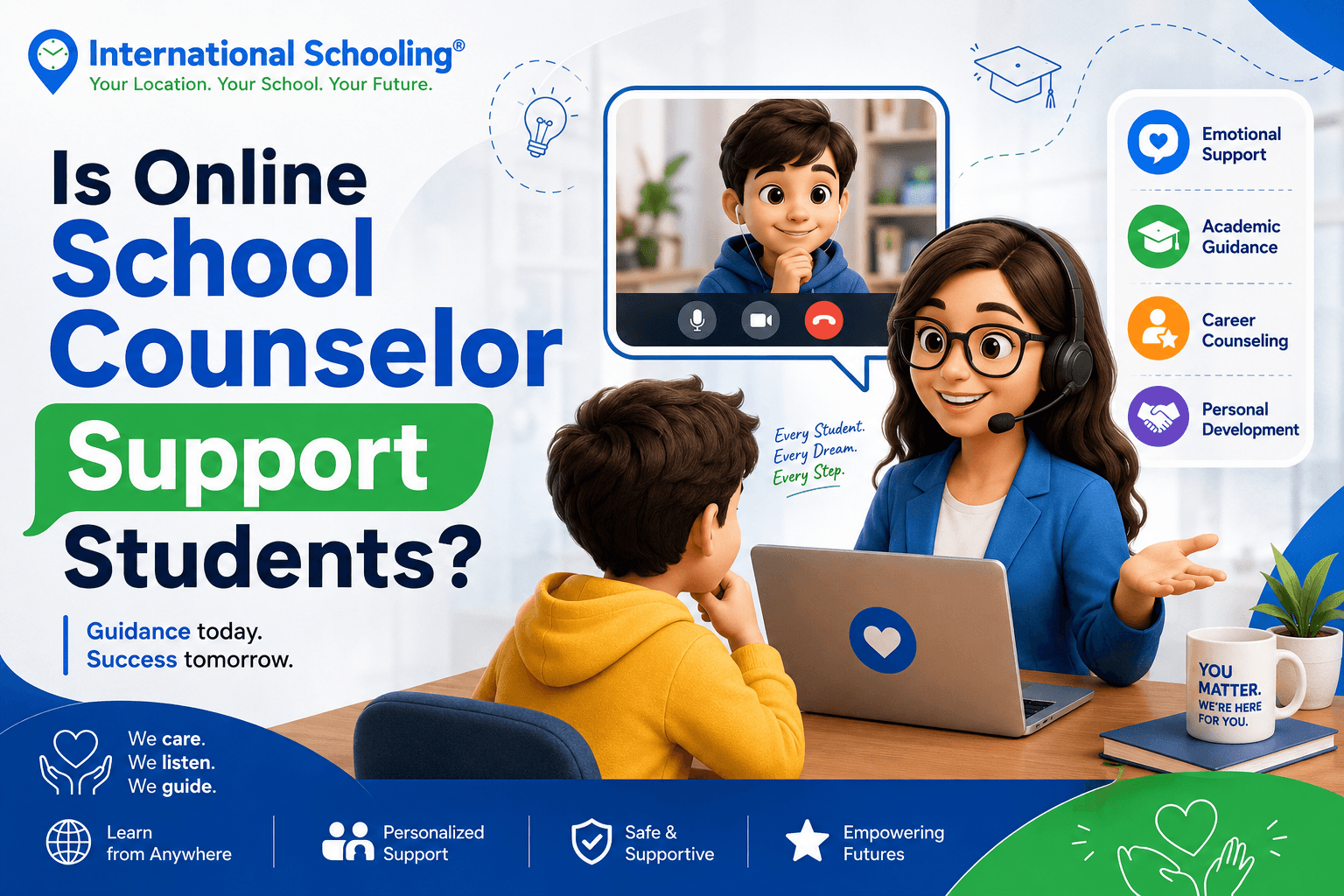
Okay, so let's get specific, because "we have counseling services" doesn't really tell you anything. A well-run online school tends to break this into three layers.
Academic counseling
Is the one everyone expects — help picking classes, staying on pace for graduation, that kind of thing. Done right, it's not a one-time phone call at the start of the year and then radio silence. It's ongoing, usually tracked through some kind of shared dashboard that both the counselor and the student can check.
According to the U.S. Bureau of Labor Statistics, Openings for K-12 school and career counselors are projected to grow by 11% from 2016 to 2026, creating 33,000 new jobs.
College and career counseling
Kicks in for older students — transcript planning, test prep guidance, help navigating applications. It's basically the exact same job a counselor does at a physical high school. The only difference is that it happens over video calls, email, and messaging instead of someone popping into an office during a free period.
Social-emotional support
Is the one parents actually worry about, and fairly so. This is where you want to see licensed counselors — or a partnership with actual mental health professionals — who can meet with kids one-on-one, loop parents in when it's appropriate, and point families toward outside help when a problem is bigger than what a school can address.
If there's one thing the good programs have in common, it's this: your kid gets a specific counselor, not a shared inbox that whoever's logged in happens to answer. That continuity matters more than people realize. Kids open up to someone they already trust. They don't open up to a rotating cast of strangers.
The Access Problem — And Why It Cuts Both Ways
Here's something that tends to catch parents off guard: for some kids, counseling access online can actually be better than what they'd get in a traditional building.
Consider a counselor at a big public high school. The recommended ratio, according to the American School Counselor Association, is one counselor per 250 students. In practice, plenty of U.S. states are sitting closer to 400 or 500 students per counselor. At that ratio, a kid can be quietly falling apart for months, and nobody catches it — there just aren't enough hours in the day.

A smaller online school, or one that assigns counselors by grade level or cohort, can sometimes give a student more real one-on-one time than an overcrowded traditional school ever could. That's the upside. The catch is it only works if the school actually puts money and staff behind it. A cheap, under-resourced online program can leave a kid just as unsupported — arguably more so, since there's no hallway run-in or lunchroom moment where a teacher happens to notice something's off.
So the honest answer isn't "online is better" or "online is worse." It's that online school changes what counseling has to look like. There's no physical proximity to lean on, so the school has to be deliberate about reaching out — it can't just wait for someone to wander by.
What Separates the Good Programs From the Ones Just Checking a Box
A few things tend to show up whenever you look at a school that actually does this well:
• They check in first — they don't wait to be asked.
Struggling kids almost never raise their hand and say, "I need help." A counselor who reaches out on a schedule catches things that a counselor sitting behind an "open office hours" sign never will.
• They keep parents actually in the loop.
No hallway chats, no bumping into a teacher at pickup — so the updates have to happen on purpose, and more of them, not fewer.
• The staff are actually licensed.
Not an academic advisor with "counselor" tacked onto their title. Real emotional support takes real training.
• They know when to hand things off.
A good program isn't afraid to say "this is beyond what we can do here" and has an actual referral process ready when that happens.
• They let kids choose how they want to talk.
For a lot of teenagers, a video call can feel more exposing than sitting across from someone in an office. The better schools offer text, phone, or video, and let the student pick.
Questions Worth Asking Before You Sign Up
If counseling matters to you when you're picking a school — and honestly, it should — just ask, directly:
Is my kid getting one dedicated counselor, or whoever's available that day?
What's the counselor-to-student ratio, actually?
Are these licensed mental health professionals, or academic advisors wearing a different hat?
How exactly do you communicate concerns to parents?
What happens if my child needs more help than the school can give?
If a school answers those clearly and specifically, that's usually a good sign. If all you get back is "we offer full support services" with nothing behind it, take that as your answer too.
The Bottom Line
Counseling in online school is real, and when a program does it right, it can genuinely rival — sometimes even beat—what a kid would get walking the halls of a traditional school. But none of that happens automatically. It comes down to whether a school actually builds the infrastructure, hires people with real credentials, and reaches out before there's a crisis instead of after.
At the end of the day, the building was never really the thing that made counseling work. It was always the relationship — someone who remembers what you told them last time, who checks in without being asked, who's actually paying attention. Online schools can absolutely offer that. The good ones just have to work a bit harder to make sure it's real and not just a line on their website.
Mira Lew
Aug 18, 2026